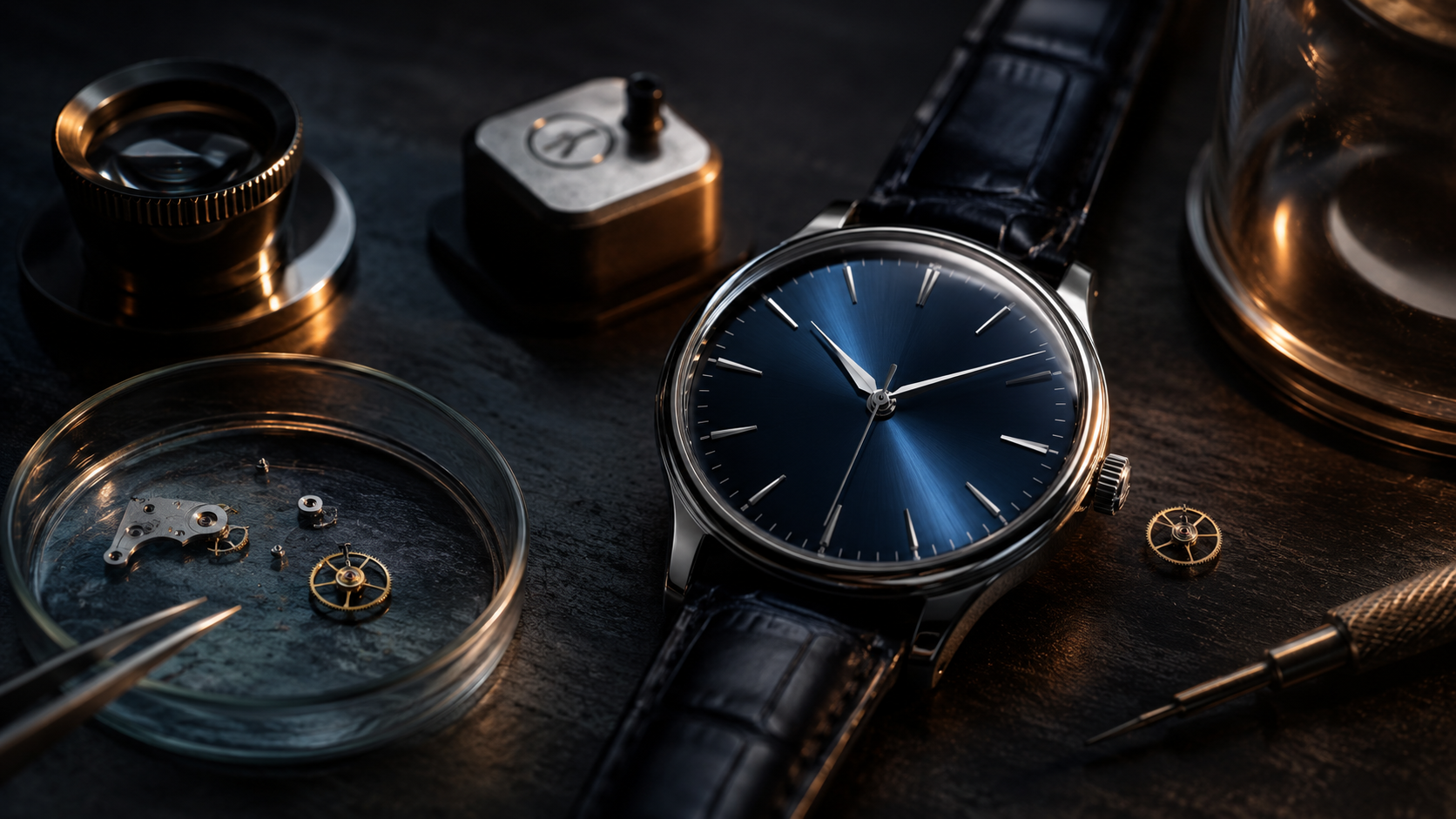
Why Did My Watch Suddenly Stop Working? 12 Reasons You May Not Expect
A watch rarely gives you a warning before it stops. One moment it is keeping time normally; the next, the hands seem frozen.
Sometimes the problem is relatively straightforward. Other times, a stopped watch is simply the first visible sign of something happening deeper inside the movement.
we believe the useful question is not just “How do we make it tick again?” but “What caused it to stop in the first place?”
Here are 12 possibilities worth investigating.
1. The Movement Has Reached the End of Its Service Interval
Mechanical movements depend on extremely small components working together with very little friction. As lubricants age and operating conditions change, resistance inside the movement can increase.
Eventually, the watch may lose accuracy, develop a reduced power reserve, or stop altogether.
2. Your Automatic Watch Isn't Receiving Enough Wrist Movement
An automatic watch uses the movement of your wrist to help wind its mainspring.
If the watch has spent several days off the wrist—or your daily activity has changed—it may simply run out of stored energy.
But if a normally worn automatic watch repeatedly stops, that deserves a closer look.
3. The Rotor Isn't Winding the Watch Efficiently
Wearing an automatic watch doesn't necessarily mean it is being wound correctly.
A problem in the automatic winding system can allow the rotor to move without transferring enough energy to the mainspring. The result can look confusing: the watch runs after manual winding but repeatedly stops during normal wear.
4. Magnetism Is Affecting the Movement
Phones, speakers, magnetic clasps, electronic equipment and other everyday objects can expose a mechanical watch to magnetic fields.
A watchmaker can test for magnetism rather than guessing.
5. A Previous Shock Has Shifted Something Inside
The outside of a watch can look perfect after a knock while something inside has changed. A hard impact may affect delicate movement components or even cause a hand to make unwanted contact. The problem may appear immediately—or become noticeable later.
6. The Hands Are Touching Each Other
This is an interesting fault because the movement itself may still be trying to run.If the hour, minute, or seconds hand becomes slightly bent or displaced, two hands can touch. A hand can also make contact with the dial or crystal.
That small obstruction can prevent the hands from advancing correctly.
7. The Date Mechanism Has Become Jammed
Your date display is connected to additional components underneath the dial.
A fault in this mechanism can create enough resistance to interfere with the watch's operation. If your watch repeatedly develops problems around the time the date changes, that detail can be valuable during diagnosis.
8. The Crown Isn't Properly Engaging the Movement
The crown does much more than adjust the time.
Through the winding and setting mechanism, it communicates your inputs to the movement. Damage or wear in this system can create unusual symptoms—including difficulty winding, setting, or restarting the watch.
Never force a crown that suddenly feels different.
9. A Movement Component Has Become Loose
Inside a mechanical watch are screws and extremely small components operating within precise tolerances.
If something becomes loose, the effect can range from poor timekeeping to complete stoppage. Continuing to shake or repeatedly wind the watch isn't a good way to diagnose it.
10. The Watch Runs in One Position but Stops in Another
This is one of the more revealing symptoms.
Perhaps your watch works while lying flat but stops overnight, or runs on your wrist but stops when placed crown-side down.
Position-dependent stopping can point a watchmaker toward problems involving the movement's regulating or rotating components. Tell your technician exactly when the watch stops—it can help enormously.
11. An Earlier Repair Has Created a New Problem
Not every fault begins naturally.
Incorrect assembly, unsuitable components, excessive lubrication, missing parts, or previous repair work can affect how a movement operates.
This is particularly important with vintage watches, where a long service history may not be fully documented.
12. The Watch Isn't Actually “Stopped” for the Reason You Think
Sometimes the visible symptom can be misleading.
A seconds display may behave differently by design, a chronograph seconds hand may remain stationary until activated, or another complication may be misunderstood as the normal seconds indicator.
A proper diagnosis begins by identifying the movement and understanding exactly how that particular watch is supposed to operate.
Don't Guess From the Symptom Alone
Two watches can arrive with exactly the same complaint—“My watch stopped”—and have completely different faults.
That's why professional diagnosis matters, particularly for mechanical, vintage, complicated, or high-value watches. The goal isn't simply to restart the watch. It's to understand what caused the failure and determine the appropriate repair.
If your watch has suddenly stopped, is stopping intermittently, or no longer behaves the way it used to, Geneva Watch Company can inspect the timepiece and help determine what's happening inside the movement.